Commercial Roofing in Plano, TX
Most Plano offices, storefronts, and warehouses sit under a flat or low-slope roof that gives out on a timeline you can see coming, and a local roofer reads the membrane early, dates each weak spot, and hands you one written number before anything is booked.
- Free, documented roof inspection
- The scope and the number, in writing
- Plain-English claim help, on your side
Call (469) 277-7654
Where a Plano commercial roof gives way first
A near-flat roof does not shed water the way a pitched house roof does. It holds a sealed membrane overhead and leans on its drains and a slight fall to walk the water off, so it fails wherever the water stops moving, not out across the open field. The sequence rarely surprises a roofer who reads these often.
Start at the drains and scuppers: plug one and the roof holds a shallow pool that bakes everything under it. From there the trouble tracks to the seams, the welded or lapped joints between sheets that split first under standing water, then to the wall flashing where the membrane turns up a parapet, and last to the collars around each rooftop unit, the HVAC curbs, vents, and pipes punched through the plane. A local roofer walks that list in a set order and leaves a dated photo on each spot, so the file shows exactly where the roof stands before a single price is named. That read starts with a documented free inspection.
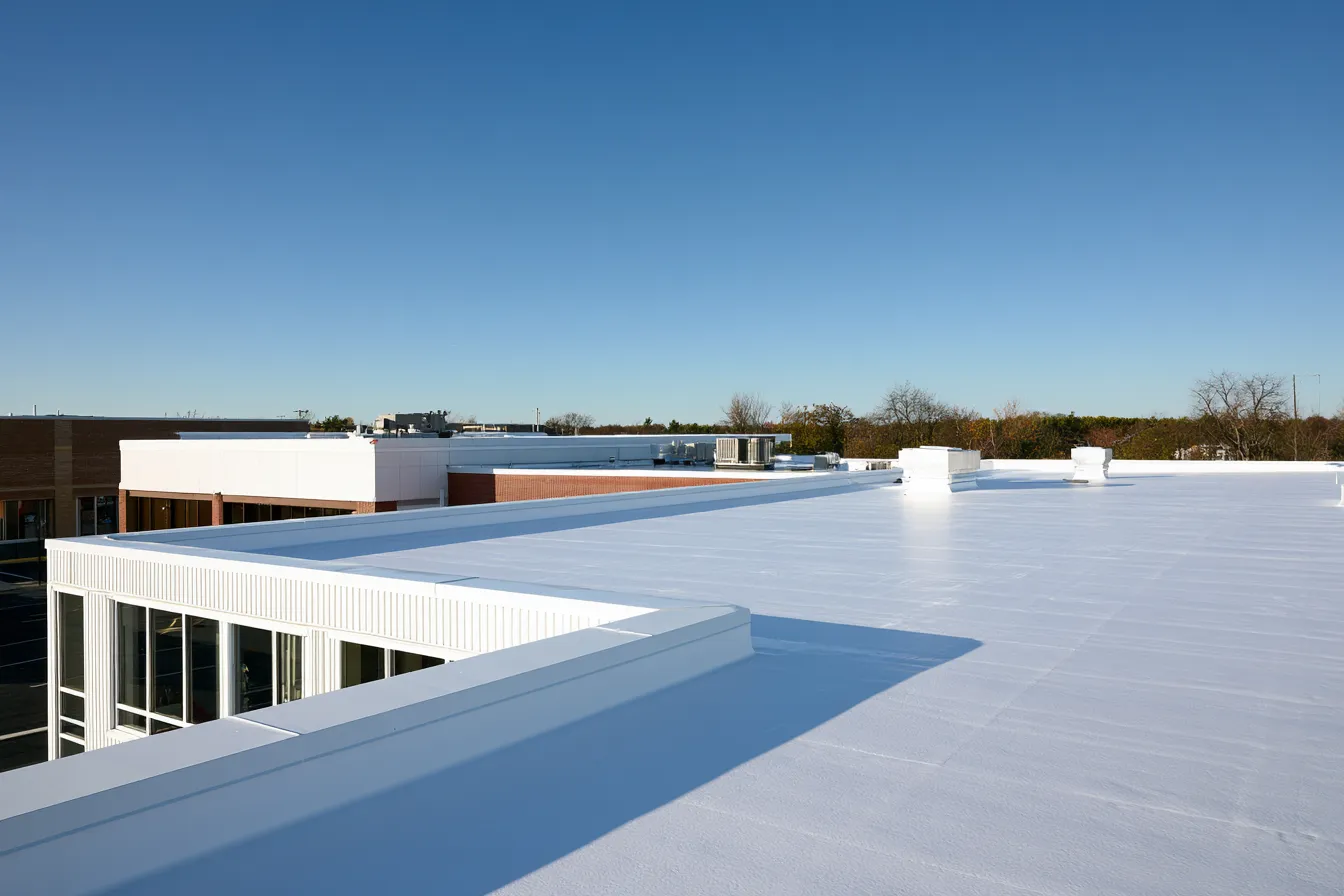
Commercial roof systems a local roofer installs in Plano
No flat roof has one right system. The pick turns on the building itself: how much rooftop traffic the membrane takes, whether kitchen or shop exhaust vents across it, how the deck drains, and what the budget carries. These are the low-slope and flat-roof systems local roofers install and service around Plano, matched to your building only after the roof is read and documented, never off the back of a truck.
TPO
A single-ply sheet joined with hot-air welds, the common pick when a newer Plano office or retail box goes flat; its pale, reflective top bounces the Texas sun and eases the summer cooling load.
EPDM
A rubber membrane that trades looks for staying power, decades of low-fuss service across wide decks, which is why it turns up over Plano warehouses and long-standing light-industrial stock along the tollway corridors.
PVC
A welded sheet built to shrug off grease, oils, and cooking fumes, so it lands on restaurants and any building where a rooftop vent breathes exhaust across the deck.
Modified bitumen
Asphalt in torched or bonded plies, tough underfoot and under standing water, which suits roofs where crews walk and service rooftop equipment on a regular basis.
Built-up roof (BUR)
The old tar-and-gravel build, stacked in redundant plies into a heavy, proven deck that plenty of established Plano buildings still wear well.
Roof coatings
A fluid-applied coat that buys years back on a still-sound but tired flat roof at a fraction of a tear-off, laying a bright, often warrantied skin over the top.
Not sure which membrane is overhead right now, or whether last spring's hail did more than it looks? That is what the read is for: a local roofer names the system, grades its condition, and documents it before you commit to a repair or a re-roof. Storm damage gets logged against the Plano hail record the same day.
What a commercial roofing job covers
Replacement, targeted flat-roof repair, restoration, and a straight call on which system your Plano building actually needs.
- 01Full re-roof or new membrane
- A new low-slope system sized and fastened to the deck, single-ply, modified bitumen, or a built-up build, for a roof that is truly finished rather than one a repair keeps carrying.
- 02Targeted flat-roof repair
- The weak spots handled one at a time: ponding, backed-up drains, seams that lift or split, wall flashing, and the collars sealing HVAC curbs and pipe penetrations, each traced and matched to whatever membrane is already up top.
- 03Restoration by coating
- A fluid-applied coat that adds years to a flat roof whose membrane still holds, at a slice of a tear-off, and exactly the wrong move once that roof has truly gone.
- 04The straight system call
- Rooftop traffic, grease or chemical exposure, drainage, and budget settle the system; a local roofer fits it to the building instead of reaching for whatever installs fastest.
Wind or hail on a commercial roof runs the same track as a house: a local roofer logs the damage against the storm date so you can weigh it from facts, then walks you through a commercial insurance claim if one is worth opening.
How a Plano commercial roof job runs, step by step
Documented first, priced before a nail, staged around your open hours.
Get the whole roof documented
A local roofer covers the flashing at every rooftop curb, the drains, the welded seams, and the open membrane, then hands back dated photos beside one written figure. Nothing is booked until both are in front of you.
Stage it around your hours
Repair or full replacement is spelled out in plain terms and scheduled to keep your doors open and tenants working, with the number pinned down before a crew shows up. What happens next, and when, stays your call.
Build it, then verify
The new membrane goes down, or the fix is completed to the written spec, and the seams and drains get a final check before the workmanship is put on paper for the file.
Plano commercial roofing questions
What Plano building and property owners ask before a flat or low-slope roof goes on file.
Q1Do you handle flat and low-slope roofs, or only pitched ones?
Q2TPO or modified bitumen, which belongs on my building?
Q3Does insurance cover hail or wind damage on a commercial roof?
Q4Will the work shut my business down?
Q5Why does water sit on my roof instead of draining off?
Q6Is a coating a real fix or just a patch over a failing roof?
Get your Plano commercial roof documented, free
Bring the building to Plano Premier Roofing and a local roofer sizes up the membrane and every weak spot, folds repair or replacement into a single price in writing, and stages the job around your open hours. No pressure, and nothing starts until you give the word.